Glass Top Stove Cracked? Here Is What to Do
A cracked glass cooktop stops a kitchen fast. The surface might still heat, but it is no longer safe. The ceramic glass on a radiant or induction range carries weight, heat, and electrical insulation duties all at once. A visible crack means the surface can no longer contain heat evenly or shield energized components from contact. That is why the right next step in Des Plaines is an immediate professional evaluation and a plan for a correct glass-top replacement that matches the range by model, brand, and electrical spec.
Unique Repair Services Inc. Sees glass cooktop damage across Des Plaines zip codes 60016 and 60018, and in nearby Park Ridge, Mount Prospect, and Niles. Homes around the Dempster Street, Golf Road, and Northwest Highway corridors often run long cooking cycles and host multi-generational households. Heavy cookware use, small impacts, and thermal shock add up. When a glass top cracks, the safest outcome is a controlled shutoff, followed by a same-day or next-day service visit for precise measurement and parts matching. Anything short of that risks a bigger failure and higher repair cost.
Why a cracked glass top is urgent in Des Plaines kitchens
Thin ceramic glass is strong under even pressure. It fails fast when hit at a point or when heat expands one zone more than another. A hairline crack can lengthen with normal burner cycling. When that spread reaches a radiant surface element or an induction coil zone, heat travels where the cooktop can no longer manage it. On radiant models, leaked heat can stress the radiant surface element and the insulation around it. On induction models, a crack can change how the magnetic field couples to the pan. Either way, heat control falls out of spec and safety margins disappear.
For homes along the Cumberland and Oakton Manor areas, it is common to run 240V electric ranges on older NEMA 14-50 or 6-50 receptacles that have seen decades of use. That is fine when contacts are tight. It turns risky when a cracked top makes a user press and slide heavy pots to find a hot spot. The extra strain vibrates the cord and outlet. If the 240V receptacle is already worn, the vibration can cause intermittent arcing and scorched blades on the power cord. Many residents think the crack is the main issue when the real secondary risk is hidden in the outlet behind the range.
How glass cooktops fail in the field
Technicians diagnose three causes most often in Cook County homes. First is point impact from cookware, especially cast iron pans set down hard on a hot surface. Second is thermal shock from cold liquid splashed across a red-hot radiant element zone, which contracts the glass faster at the splash point than the surrounding area. Third is cabinet or countertop irregularity under the range. If the range is not level front to back across the cooktop frame, the glass holds a slight twist. Over months, the twist stresses the corner near the control panel or near the largest burner. In Des Plaines split-level homes from the 1960s and 1970s, that twist is a repeating pattern because many kitchens have settled floors near exterior walls by a small amount that is enough to matter to ceramic glass.
Brand design details also shape failures. Whirlpool and Maytag radiant tops use spacer pads and a retainer lip that require exact placement on reassembly. Bosch and KitchenAid induction designs rely on cooling airflow under the glass and across the inverter board. Grease buildup in the airflow path overheats the zone under the largest cooking area, which can make the surface more sensitive to thermal shock. GE and Frigidaire ranges may pair a large dual radiant element with a fast-heat profile. If cookware sits over only part of that dual zone on high, the edge sees a sharp temperature gradient that ages the glass faster. None of these patterns are defects. They reflect trade-offs between fast heating, quiet operation, and a low-profile design. The fix is a correct glass replacement and a quick verification that level, clearance, and airflow match the manufacturer’s setup notes.
Radiant vs induction under a cracked top
A radiant electric cooktop uses a radiant surface element that glows under ceramic glass. The glass spreads heat and offers a smooth cooking surface. When cracked, the element can heat unevenly, and the glass can flex. It also no longer insulates as designed. A deep crack that reaches the bezel or an edge means the glass piece has lost structural support. Replacement is the right call.
An induction cooktop places an electromagnetic coil beneath the glass. The coil makes the pot itself heat up. The glass does not need to get as hot as a radiant top, but it still supports cookware weight, protects the coil, and allows precise temperature sensing. A cracked induction surface can cause misreads or create an uneven standoff height for the pan. That changes pan detection reliability and can cycle the inverter on and off. In the field, that shows up as flashing power levels or a persistent fault code on Bosch, Samsung, or GE Profile induction units after a visible crack starts. The safe path is the same. Replace the glass surface with a new OEM panel and inspect cooling fans and ducting while the unit is open.
Local electrical factors that ride along with a cracked top
Older Des Plaines homes, especially those built 1950 through 1985, present a second cause that homeowners do not expect. The 240V receptacle can wear just enough to cause low-voltage under load or micro arcing at the terminal block. A cracked top draws attention, but the power circuit behind the range may be the hidden problem that shortens element life or trips the breaker during preheat. Unique Repair Services tracks a pattern in Cumberland, Apollo, and the Dempster-Lee corridor where receptacle wear is the first failure in as many as four out of ten calls where the customer reports two radiant burners failing at once or a cooktop that only heats on high. The cooktop glass is not always broken in those calls, but the pattern is instructive. When a glass top cracks, it is the right time to check the outlet, cord, and terminal block in one visit.
Technicians look for NEMA 14-50 or NEMA 6-50 receptacles with heat discoloration, a loose hold on electric stove repair in Des Plaines IL the plug, or a brittle power cord jacket. They measure voltage under load to confirm 240V between the two hot legs and 120V from each hot leg to neutral where applicable. If numbers sag during preheat or when two burners run, the outlet should be replaced. That work keeps a new glass top from living over an unstable power source that would put the next element or control board at risk. This detail matters on Whirlpool, GE, Frigidaire, and Kenmore models that rely on an infinite switch for heat level control. Low voltage can make an infinite switch cycle harder, which overheats contacts and can cause the “stuck on high” complaint many residents report.
What happens during a proper glass top service call
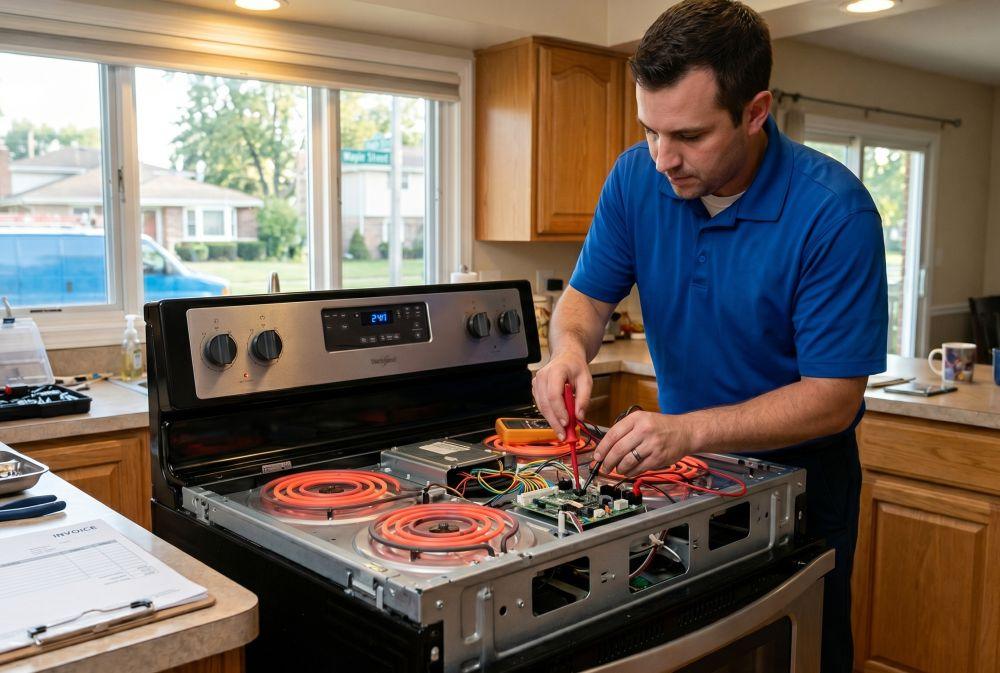
The service starts with documentation of the model and serial number. That number locates the exact glass panel and gasket profile. The technician then confirms the failure. If the range is safe to power, a quick test of each radiant surface element, the surface element switch, and the control board verifies no secondary damage occurred. On induction, the technician checks that pan detection works and that no inverter or sensor codes are active. With the diagnosis complete, the cooktop surface comes off the chassis. Technicians set the cracked panel aside and clean the tray. They inspect spacer pads, ground straps, retainer clips, and the wiring harness for heat marks or pinch points.
Then they dry fit the new ceramic glass surface to ensure perfect alignment with the chassis, especially around the touch panel and control knobs. On many KitchenAid and Frigidaire units, misalignment by even a few millimeters can cause a bind on the control bezel or a strain near the front edge. The technician sets the panel, reconnects any ground wires that tie the frame to the surface, and verifies that each radiant element or induction coil sits at the designed standoff height. A final test includes bringing each burner to temperature, confirming even heat, and then cooling the unit to confirm that thermal cycling is quiet and free of pops that suggest stress under the glass. That process sounds simple, but it takes a practiced hand. The difference shows months later when the surface stays quiet, level, and scratch free.
Cost context and the repair vs replace line
Local homeowners ask about cost early, and they should. Across Cook County, electric stove work that does not include a glass panel often falls between $108 and $251 for common fixes, based on Angi and local market tracking, with diagnostic fees running about $75 to $100 and applied to the repair. Glass cooktop replacement is a larger part cost. Price varies by brand, size, color match, and availability. A 30-inch black ceramic glass panel on a Whirlpool radiant top differs from a 36-inch gray speckle on a Bosch induction unit. The labor time also changes with how the surface mounts and how much chassis disassembly the brand requires.
The 50 percent rule is a good line for decision making. If the glass panel and any collateral parts approach half the price of a comparable new range, consider a replacement. Many Des Plaines residents choose replacement when a cracked top coincides with a failing control board or a repeated surface element board failure that knocked out two burners at the same time. That dual failure pattern happens on some GE and Samsung models where a single surface element board controls multiple zones. The board can live a long life. It can also fail in a way that looks like two elements burning out together. A good technician catches the pattern and saves a second visit by quoting the board with the glass if needed.
Signs the cooktop should be powered off now
There is a difference between a surface chip and a structural crack. The list below covers warning signs seen often in Des Plaines service calls near Lake Opeka, the Downtown Des Plaines condos along River Road, and the Oakton Street corridor:
- A crack that runs to the edge or crosses a burner circle A clicking or faint buzzing sound when a burner cycles on a cracked area Visible moisture or grease trapped in the crack line after cleaning Any soot mark or hot spot near the crack during use Burners cycling on high only or a surface element that will not shut off
Any of these signals call for a full stop. Shut the range off at the breaker until a technician inspects it. In apartments along South River Road and in condos near Metropolitan Square, that might mean coordinating with building maintenance to access the panel. The short pause prevents a minor failure from turning into a control board short or a terminal block meltdown that doubles the ticket.
Brand and part details that matter in a glass top call
Whirlpool and Maytag radiant models use bake and broil elements in the oven cavity and a separate set of radiant surface elements up top. The glass panel must match the cutouts that align to each element. KitchenAid and Jenn-Air models may share chassis templates with Whirlpool but use different bezel or control layouts that change part numbers. GE Appliances and GE Profile models often use model-specific trim kits that hold the front edge. Frigidaire and Electrolux sometimes use multiple glass suppliers under one model family. The serial number range matters because the screw boss layout changed mid-series. Samsung and LG induction units rely on precise spacing above the induction coil and exact contact with thermal sensors. All these details drive why a local service that carries factory-authorized parts information is worth the call.
On radiant cooktops, technicians often replace one or more of the following with the glass if inspection finds heat stress or if the cooktop suffered an impact strong enough to break the surface:
- Radiant surface element that sits under the cracked zone Surface element switch or infinite switch that cycled hard under low voltage Surface element board that controls two or more burners on select brands Terminal block if the range saw arcing or heat discoloration near the cord Touch panel or control board bezel if the break reached the control area
A shareable local finding about Des Plaines electric ranges
One field pattern surprises many homeowners and even some handymen. In Des Plaines homes built 1950 to 1985, worn 240V receptacles are the top hidden cause of electric range complaints that look like element failures. In service data Unique Repair Services compiled from calls in 60016 and 60018 over the last two years, intermittent low voltage at the NEMA 14-50 outlet produced at least one burner that would not heat to medium on 3 out of 10 ranges inspected. Homeowners almost always suspected the heating element. The fix was a new receptacle and power cord with tight contacts. That small repair often restored normal heat and extended the life of infinite switches and elements. When a glass top cracks in the same home, it makes even more sense to evaluate and correct the receptacle at the same time so the new surface runs on a stable 240V supply.
This pattern is shareable because it affects safety and cost across a wide slice of the city’s housing stock. Residents in Parkwood Estates, Big Bend Lake area, and Forest View who run older ranges should consider a quick outlet and cord check, especially after a visible surface failure. It is a short inspection that pays back by preventing repeat burner failures and by protecting new glass surfaces from hot-cold cycling caused by a power sag.
Cookware, cleaning, and long-term durability
Des Plaines cooks use cast iron for searing, stainless for boiling, and aluminum-clad pans for everyday work. All of them work on radiant surfaces. Only magnetic stainless or cast iron works on induction. The surface survives best when heavy pans are lifted, not slid. Cleaning matters. Ceramic glass handles nonabrasive pads and a cooktop cleaner that removes residue without scratching. Residue that stays under a pot edge forms hard rings that hold heat. That heat sharpens the temperature gradient at the crack risk points near the edge of a burner. Over months, those gradients age a surface more than most households realize.
After a replacement, technicians recommend a short break-in pattern on radiant models. Run each burner up to medium, then to high for a minute, then back down. That controlled cycle checks the set and confirms good contact between the glass and the element holders. It also lets a homeowner hear the normal thermal sounds. Later, if a tick or creak returns, that audible change can flag an alignment drift before any visible issue appears. On induction, a post-replacement test with a few pan sizes verifies that the sensor picks up even smaller pans and that power modulation is smooth at low settings.
Common questions heard on Des Plaines calls
Can a small chip be left alone? If the chip is shallow, outside any burner circle, and not connected to a crack line, it may be cosmetic. If the chip shows white crystalline edges or exposes a rough cavity that catches a fingernail, it is more than cosmetic. Heat can turn a chip into a crack. The safer choice is a technician inspection.
Does insurance cover a glass top? Some homeowners policies will cover impact damage for a range that is part of a built-in kitchen, especially if a contractor caused the impact. Policies vary. Many residents in condos near the River Road corridor carry policies that treat the range as personal property with different coverage than built-ins. A visit report that documents impact and part numbers helps claims move faster.
Is there a fix that does not replace the glass? Temporary glass adhesives do not restore strength or safety. Ceramic glass on a cooktop needs to be intact to do its job. Applying any patch turns cooking into a test of a material that is not rated for high heat. Technicians do not recommend or perform patches.
Will a replacement panel match the color exactly? OEM panels match by part number. On older models, available panels may have a slightly different tint if the series changed suppliers. The technician will explain any known tint variance by model before ordering. The priority is a correct fit and full thermal performance. In many kitchens, the color difference is minor and hard to notice once installed.
Why local context matters in glass top work
The Des Plaines grid puts many homes within minutes of Unique Repair Services headquarters at 95 Bradrock Dr, just off Lee Street and near Mannheim Road. That proximity drives quick response to Downtown Des Plaines, the Cumberland-Touhy corridor, and the neighborhoods along Oakton Street and River Road. A cracked glass top does not wait. Same-day inspection is often realistic because the company dispatches along Northwest Highway, Dempster Street, and Golf Road all day. The field team knows how to move through the I-294 and I-90 corridors to reach Park Ridge, Mount Prospect, Niles, and Glenview with minimal delay, then loop back through River Road toward Rosemont. This routing keeps common glass top and element parts within reach so more calls finish on the first visit.
Local brand mix matters too. Des Plaines homes often carry Whirlpool, GE Appliances, Frigidaire, Maytag, and Kenmore in older kitchens, with Bosch, KitchenAid, Samsung, and LG in newer renovations. Condos near South River Road and the Metropolitan Square area show a higher share of European brands like Bosch and Miele. That mix means the service vans stock radiant surface elements, infinite switches, touch panels, and common control boards for American brands, along with induction parts and cooling fans for European and Korean brands. Having the parts nearby saves a second trip and returns a kitchen to service faster.
Technical checkpoints unique to cracked-top visits
An expert cracked-top visit in Des Plaines includes checks beyond the glass and burner. The technician inspects the oven terminal block where the power cord lands. Heat discoloration or a cracked insulator here can mimic a bad surface element. They unplug the power cord and examine the plug blades for pitting that points to 240V receptacle wear. They confirm a tight strain relief where the power cord passes into the chassis. A loose strain relief lets the power cord flex and can weaken the internal connections. They look at the surface element board on brands that centralize control of two or more burners. If the board shows heat stress or a cracked solder joint, it should be replaced along with the glass to prevent double work later.
Induction units get special attention on cooling air. The technician vacuums dust, wipes grease, and spins the cooling fan by hand. A fan that hesitates or rattles must be replaced. Overheating accelerates failure of IGBTs on the inverter board and can set a fault that looks like a bad zone. The replacement glass top will not survive long if the board overheats again. Control boards and touch panels also face a moisture risk. If a crack allowed steam to rise into the control cavity, the touch panel ribbon cable may corrode. On KitchenAid and GE Profile designs that place the touch controls close to the cooking surface, this ribbon cable is easy to check and replace while the glass is off.
Examples from the field near Oakton and River Road
A homeowner near Lake Park called after a heavy skillet chipped the front burner circle on a Frigidaire Gallery radiant top. The chip spread to a six-inch crack by the next day. On inspection, the technician found the surface element still within spec, but the infinite switch showed burned contacts. The NEMA 14-50 outlet also had a weak grip. The repair included a new OEM ceramic glass panel, front radiant element as a precaution, a new infinite switch, and a new receptacle and power cord. The customer gained a stable platform and steady heat levels. The total stayed below the 50 percent replacement line for that model.
In a condo near River Road, a Bosch induction unit developed a spider crack after cold water splashed from a pasta pot. The cooktop displayed a fault on the largest zone. The technician replaced the glass panel, cleaned the cooling path, and replaced a cooling fan that seized during the event. The inverter board tested good. The unit passed final testing across all zones, and the owner learned how to avoid thermal shock events that often come from quick cool-down habits rather than from cookware weight.
Safety context on cracked glass and power supply
Residents ask if a cracked surface can cause a shock. On modern ranges, internal shielding reduces that risk, but a crack increases the chance of moisture reaching energized parts if a spill occurs. It also increases the chance Des Plaines oven and stove service of conductive debris, like salt water, bridging a path across the surface. That is why powering the unit off at the breaker is the correct step when a crack reaches the burner circle or the control area. The next risk is heat migration. Cracks concentrate stress. A hotspot can grow at a crack tip. That heat can travel to a touch panel on designs with front controls, and it can age the bezel. These are rare but real damage paths seen on Samsung and LG radiant designs after a few weeks of continued use on a cracked surface.
The power supply deserves equal attention. A glass failure creates urgency that often gets a service truck to the home faster than a slow-heating complaint would. Use that opportunity to correct any 240V receptacle wear. Doing so prevents repeat issues like a surface element that runs only on high or a control board that resets when two burners and the bake element all run at once. Stable 240V at the range and clean terminations at the terminal block pay for themselves, especially in older homes near the Des Plaines River corridor that see slight humidity swings in summer that can exaggerate poor connections.
Electric stove repair Des Plaines IL: getting the right fix the first time
Electric stove repair in Des Plaines happens in the real conditions of local homes. Floors can be slightly out of level in mid-century ranches. Countertops can overhang wider on one side in renovated kitchens along Northwest Highway. Some ranges tie into a junction box rather than a receptacle. Some are on a circuit that also feeds a microwave. A technician who sees these patterns daily assesses more than the panel. They measure voltage, level the chassis, protect the surrounding counter, and reassemble the range so the glass carries weight as designed.
The result should be a range that heats like new, looks correct from every angle, and cycles quietly. It should also sit on a proven electrical foundation with a healthy 240V receptacle or junction box, tight terminal block hardware, and a power cord with clean blades. That complete approach keeps future calls down and keeps kitchens running across 60016, 60018, 60017, and 60019.
Service positioning for Des Plaines homeowners ready to book
Unique Repair Services Inc. Is based at 95 Bradrock Dr, Des Plaines. The team serves the entire city and nearby suburbs through I-294, I-90, and the local grid along Mannheim Road, River Road, Oakton Street, Dempster Street, Golf Road, and Northwest Highway. The company provides electric stove repair, electric range repair, electric cooktop repair, glass top stove repair, and induction cooktop repair across Whirlpool, GE Appliances, Frigidaire, Maytag, Kenmore, KitchenAid, LG, Samsung, Bosch, Electrolux, and more. Technicians are manufacturer trained and the company is a licensed Illinois contractor and fully insured. Same-day and next-day appointment availability is routine. Diagnostic pricing is transparent, with the diagnostic fee applied to the repair. Parts and workmanship carry warranty coverage. Service includes homes and condos across Cumberland, Oakton Manor, Apollo, Parkwood Estates, Forest View, Riverview, Downtown Des Plaines, Lake Park, and the Dempster-Lee corridor, plus Park Ridge, Mount Prospect, Niles, Glenview, Rosemont, Elk Grove Village, and Arlington Heights.
To schedule electric stove repair in Des Plaines, including cracked glass cooktop replacement and full electrical checks, call +1-847-318-3363 or visit the electric stove service page at https://uniquerepair.com/service-areas/des-plaines/electric-stove-repair-services/. The Google Business Profile at https://www.google.com/maps?cid=4938574192076092876 shows current service hours and map directions. A dispatcher can often place a technician on the Northwest Highway or River Road routes the same day for 60016 and 60018. Book the earliest window if the crack reaches a burner circle or if any burner now runs only on high.
Unique Repair Services, Inc.
95 Bradrock Dr
Des Plaines, IL 60018
Phone: (847) 318-3363
Email: [email protected]
Hours:
Monday to Thursday: 8AM–6PM
Friday: 8AM–5PM
Website: https://uniquerepair.com
Follow Us: Facebook